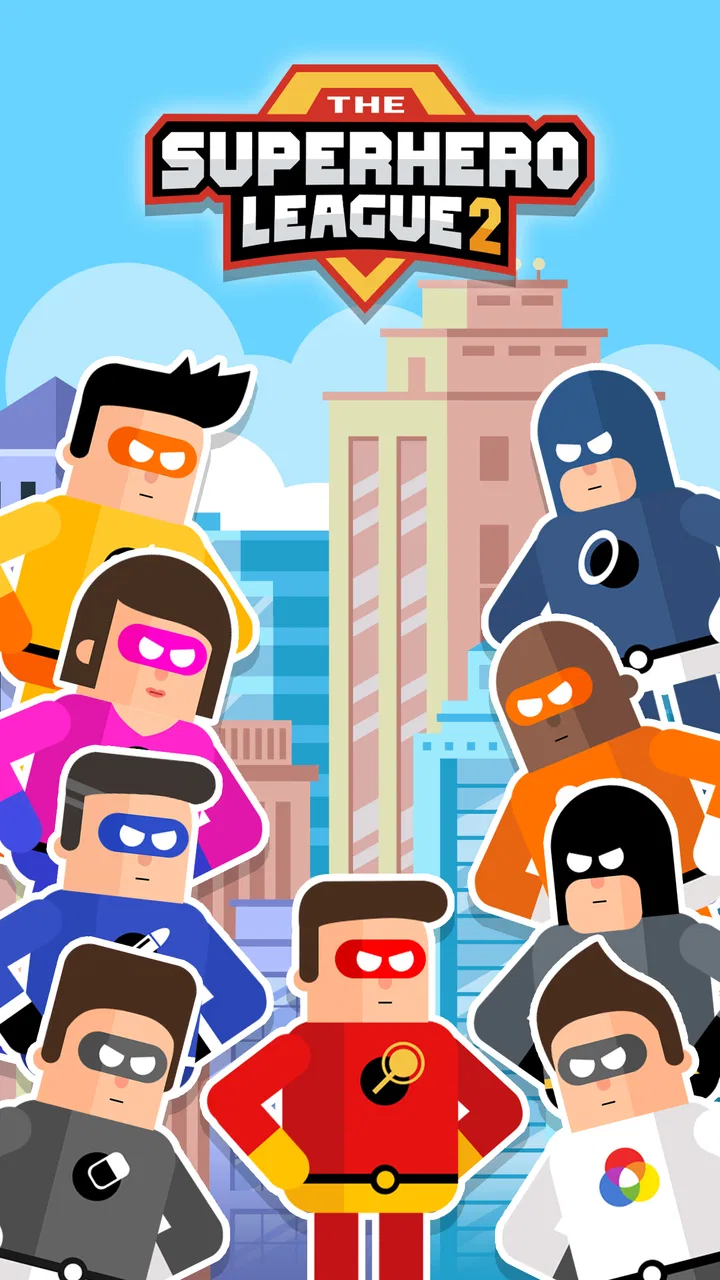
The Superhero League 2
- 4.6
- Rating
- 10.00M
- Installs
- Free
- Price
 Analysis by App-foxy
I approached The Superhero League 2 as a quick-play puzzle game rather than as a traditional action title, and that distinction matters. Its appeal is built around thinking through superhero-themed challenges, testing an idea, and trying again when the first solution fails. The presentation suggests a light, accessible experience, but the best moments come from slowing down and noticing how a level is arranged instead of rushing toward the obvious move.
Developed by Lion Studios, the game is free to download and sits in the puzzle category with a Teen content rating. It has reached over 10 million installs and holds a 4.6 average from roughly 63 thousand ratings, which tells me it has found a sizeable audience. Those figures do not replace personal experience, of course, but they do make sense once you understand the simple premise: this is the sort of game that can fill a short break while still giving you a reason to replay a tricky stage.
How the puzzle loop feels in everyday play
The core experience is easy to pick up. I can open it for a few minutes, look at the current challenge, and immediately understand that the solution depends on observation and timing rather than on learning a complicated control scheme. That makes it a comfortable choice for a commute, a waiting room, or a quiet moment when I want something more engaging than scrolling but do not want to commit to a long session.
You May Also Like

 Blood Strike: 2.5 Anniversary
Blood Strike’s Loadouts Turn Every Drop Into a Tactical Gamble
A close look at Blood Strike’s custom loadouts: how fast access to signature weapons reshapes its battle royale rhythm, rewards preparation, and narrows the gap between fights.

 Pandora - Music & Podcasts
Pandora’s Music Is Easy to Start, but Harder to Recover
Pandora’s strength is its low-effort path from a seed to a station. Its weak spot is how much confidence it asks you to place in connection, setup, and quiet recovery.

 8 Ball Pool
 Is Built on Rivalries, Rematches, and Routine
A close look at the rivalries, rematches, shared routines, and unanswered safety questions that turn a quick pool match into a persistent mobile community.

 Samsung Music
’s Quiet Strength Is Playing What You Already Own
Its reach comes less from spectacle than from dependable access to a personal library. That simplicity is both the app’s strongest retention engine and its ceiling.

 AccuWeather: Weather Radar
AccuWeather Review: A Quick, Clear Forecast for Everyday Decisions
For everyday plans, the best forecast is the one you can understand quickly. AccuWeather makes rain timing, radar, and local conditions easy to act on, with a few trade-offs.

 Hill Climb Racing
Why Hill Climb Racing Still Turns Crashes Into One More Run
A tiny car, a bumpy hill and one more upgrade: Hill Climb Racing keeps resurfacing because its simple chaos makes every near-miss feel personal.
More From Our News Desk



A typical use case is a short break between tasks. I might start a level expecting to finish it quickly, notice that the straightforward approach does not work, and then spend another minute examining the layout. That small shift—from acting immediately to planning first—is where the game earns its place as a puzzle title. It rewards curiosity more than reflexes, even though the superhero theme gives the presentation a more energetic personality.
The game is also approachable for players who do not usually choose complex puzzle games. There is no need to study a large rulebook before starting. The visual language does much of the explaining, and experimentation is part of the process. If you make the wrong choice, the natural response is to try another route rather than abandon the game entirely.
That simplicity has a trade-off. Players who want deep story development, a large cast with detailed abilities, or a long-form adventure may find the experience lighter than expected. The superhero setting is useful for making the puzzles feel distinctive, but I would not choose this as a replacement for a narrative-heavy role-playing game or a competitive action game. Its strength is focused problem solving, not a broad fictional world.
Small decisions matter more than fast reactions
One of the more useful habits I developed was to pause before making the first move. In many puzzle games, speed creates a sense of progress, but here an impulsive action can hide the actual structure of the challenge. I found it more effective to identify the obvious objective, then ask what the level seems to be encouraging me to overlook. That approach reduces unnecessary retries and makes the successful solution feel earned.
I also recommend treating failed attempts as information rather than wasted time. A failed move can reveal which part of the arrangement is fixed, which action creates a problem, or which assumption was incorrect. This is especially helpful when playing during a short break, because it gives each attempt a purpose. Instead of repeatedly tapping at random, I can change one decision at a time and understand why the outcome changes.
Another practical tip is to avoid judging a level by its first few seconds. Puzzle games often make the initial route look obvious, and that can tempt players into repeating the same idea. When I feel stuck, I stop trying to force the expected answer and inspect the whole screen again. That reset in attention is often more valuable than simply attempting the same move faster.
Who will enjoy the design, and who may not
I would recommend this game to someone who likes compact challenges, playful superhero themes, and the satisfaction of finding a solution without needing a long tutorial. It is particularly suitable for people who prefer games that can be played in brief sessions. The free entry point also makes it easy to test the basic experience before deciding whether it deserves a permanent place on a phone.
I would be more cautious about recommending it to anyone who dislikes repetition. Puzzle progress naturally involves retries, and the enjoyment depends on being willing to revisit an idea after it fails. If repeating a stage feels frustrating rather than satisfying, the superhero presentation will not solve that underlying issue.
It is also not the best fit for a player looking for a serious competitive environment. The pleasure comes from solving the challenge in front of me, not from proving that I am faster or stronger than another player. Someone who wants ranked matches, elaborate team building, or constant social interaction would probably be happier with a different type of mobile game.
Free access, purchases, and the pressure to spend
The game is free, with optional in-app purchases listed from $0.99 to $5.99 per item. That gives the download a low-risk starting point: I can try the puzzles without paying upfront and decide based on the actual play experience. For a casual player, that is a sensible arrangement, particularly when the main attraction is discovering whether the puzzle style matches personal taste.
From a spending perspective, I would set a simple rule before playing: enjoy the free experience first and only consider a purchase if it solves a clearly understood inconvenience. I would not spend merely because I had just failed a level or felt impatient. That kind of moment is exactly when a purchase can feel more attractive than it really is.
The listed purchase range is clear, but it does not by itself explain how spending affects progression or whether every item is optional in practice. I therefore would not promise that purchases are irrelevant, nor would I claim that the game is unfair to non-paying players. The responsible conclusion is narrower: the game can be started for free, purchases are available, and the effect of those purchases should be judged from the options shown during actual play rather than assumed in advance.
That uncertainty is important for families. The Teen rating means parents should review the game themselves before allowing younger players to use it, and device-level purchase controls are sensible whenever a game offers paid items. This is not a criticism unique to this title; it is simply a practical step that prevents an enjoyable puzzle session from turning into an unwanted charge.
Fairness, progression, and the questions I would ask before installing
Before installing, I’d think about what makes progress feel fair to me: whether I enjoy working through a puzzle unaided, how I react to retries, and whether optional purchases feel like a convenience or a nudge when I’m stuck. Those questions are more useful than assuming a free game will suit every player equally. They also lead to the practical issue that matters next: how the game behaves during ordinary sessions on a particular device.
Does spending decide whether the puzzles are winnable?
I would not describe the game as pay-to-win based only on its category, free price, and purchase range. Puzzle games are judged differently from competitive multiplayer games: the central question is whether the challenge can be understood and solved through play, not whether a paying player can defeat another person. Still, the presence of purchases means I would pay attention to whether the game repeatedly interrupts a failed attempt with pressure to buy help.
My practical advice is to observe the first several sessions. Notice whether the game lets you keep experimenting, whether a retry feels reasonable, and whether paid options are presented as conveniences or as the only comfortable way forward. That observation will tell you more about fairness than the existence of a small purchase alone.
Can progress feel pressured even when the game is free?
Yes, any free mobile game can create pressure through pacing, repeated failure, or interruptions, but I would avoid pretending to know the exact structure without seeing every stage and purchase prompt. What I can say from the design is that puzzle difficulty itself can create an emotional push: after investing time in a level, a player may become more willing to accept help or spend money simply to move on.
I handle that by taking a break when frustration replaces curiosity. If I return with a clearer head, I can decide whether I genuinely want assistance or whether I was only reacting to the previous failure. This is a small habit, but it keeps the game in the role of entertainment rather than turning progress into a test of patience.
How does it compare with ordinary puzzle alternatives?
Compared with a minimalist logic puzzle, this game has a more recognizable theme and a stronger sense of character-driven presentation. That can make the individual challenges feel less abstract, especially for players who are drawn to superheroes rather than numbers, words, or pure geometry. Compared with a large adventure game, however, it is more focused and less likely to provide a substantial world to explore.
Compared with a traditional brain-training app, I would choose this when I want entertainment first and mental exercise second. It does not need to feel like a lesson to make me think. On the other hand, someone who wants carefully measured practice, extensive statistics, or a formal training structure may prefer a dedicated brain-training alternative.
The most important comparison is with other free mobile puzzle games. The free download lowers the barrier to trying it, while the superhero identity gives it a clearer personality than a collection of anonymous logic boards. The compromise is that the experience may not satisfy players who want the clean, distraction-free feel of a premium puzzle game purchased once.
What should I know about compatibility and upkeep?
The current version is 1.36, and the game requires Android 6.0 or later. That makes the compatibility requirement relatively approachable for many Android users, although I would still check the operating system on an older phone before attempting installation. The game was released on October 20, 2023, so it is not a brand-new launch, but it is established enough to have accumulated a substantial player base.
I would also keep expectations realistic about updates. A version number tells me which build is current, not how frequently new content arrives or how long support will continue. If ongoing additions are essential to your decision, treat that as something to evaluate through the app’s current activity rather than assuming that a higher version number guarantees a particular update schedule.
Is it worth trying if I only have a few minutes?
That is one of its strongest use cases. The puzzle format suits short sessions because a player can focus on one challenge, make a few attempts, and stop without losing the entire evening. I especially like this style when I want a game that gives my attention a clear target but does not demand a long setup.
The limitation is that “short session” does not always mean “low frustration.” A difficult puzzle can occupy more time than expected, and the desire to solve one last challenge can make a brief break stretch longer. I recommend starting it when you have a natural stopping point, rather than opening it during a moment when you must leave immediately.
What remains important to judge personally?
The main unknowns are not reasons to reject the game; they are reasons to test it thoughtfully. The purchase range tells me what paid items cost, but not the exact value of each item. The rating shows that many players enjoy the experience, but it does not tell me whether the difficulty suits a particular person. The Teen rating provides an age classification, but parents should still make their own decision based on the child and the way the game is used.
For that reason, I would install it with a clear evaluation plan: play enough to see how the puzzles teach their rules, notice how retries feel, and observe whether purchase prompts interfere with concentration. If the game remains enjoyable without spending and the challenges encourage reasoning rather than random tapping, it has earned a place in my casual rotation. If the pressure becomes more memorable than the solving, I would remove it without feeling that I had missed its main purpose.
My trust verdict after weighing enjoyment and spending
My overall view is positive but measured. This is a free superhero puzzle game from Lion Studios that succeeds when it keeps attention on the challenge itself. The 4.6 average and broad install base suggest strong public interest, while the Teen rating and optional purchases are reminders that it should be approached as a complete mobile product, not just as a harmless toy.
The best reason to try it is the compact puzzle loop, not the promise of endless content or competitive status. I would recommend it to casual players who enjoy experimenting, restarting, and gradually spotting the logic behind a level. I would skip it if my priority were a deep story, a premium ad-free style of play, or a competitive system where fairness can be measured directly between players.
In the end, I see it as a worthwhile free download for the right audience. Start without spending, give the puzzles a fair chance, and judge the purchase prompts by how they affect your own sessions. If solving the challenge remains more satisfying than chasing the next shortcut, the game offers a pleasant way to turn spare minutes into focused play.
FAQs for The Superhero League 2
01What is The Superhero League 2 about?
The Superhero League 2 is an action-packed puzzle game where players take on the role of superheroes with unique powers. The goal is to solve challenging puzzles by using these abilities creatively to defeat villains and save the day. With enhanced graphics and new levels, it promises an engaging experience for both new and returning players.
02Is The Superhero League 2 free to play?
Yes, The Superhero League 2 is free to play. However, it offers in-app purchases for players who wish to enhance their gameplay experience. These may include extra lives, special powers, or customization options for your superhero. While these purchases can enhance the game, they are entirely optional.
03What are the system requirements for The Superhero League 2?
The game requires Android 5.0 or later, or iOS 11.0 or later. It's designed to run smoothly on most modern smartphones and tablets. Ensure you have enough storage space available, as updates and additional content may require more room. A stable internet connection is also recommended for the best experience.
04Are there multiplayer features in The Superhero League 2?
Currently, The Superhero League 2 is primarily a single-player experience focused on puzzle-solving. However, it does offer leaderboards where players can compete with others globally. This feature allows players to compare scores and achievements, adding a competitive edge to the gameplay.
05How often does The Superhero League 2 receive updates?
The developers of The Superhero League 2 are committed to providing regular updates to enhance the gaming experience. These updates often include new levels, characters, and bug fixes. Players can expect fresh content and features periodically, keeping the game exciting and dynamic.
Pros
- Engaging superhero missions.
- Wide variety of characters.
- Smooth and vibrant graphics.
- Intuitive control system.
- Regular updates with new features.
Cons
- In-app purchases can be costly.
- Occasional ads disrupt gameplay.
- Requires constant internet connection.
- Limited offline features.
- Some levels feel repetitive.

The Superhero League 2
Gallery